


Carrier Identity Theft in Trucking: How Brokers Can Detect Stolen MC/DOT Identities
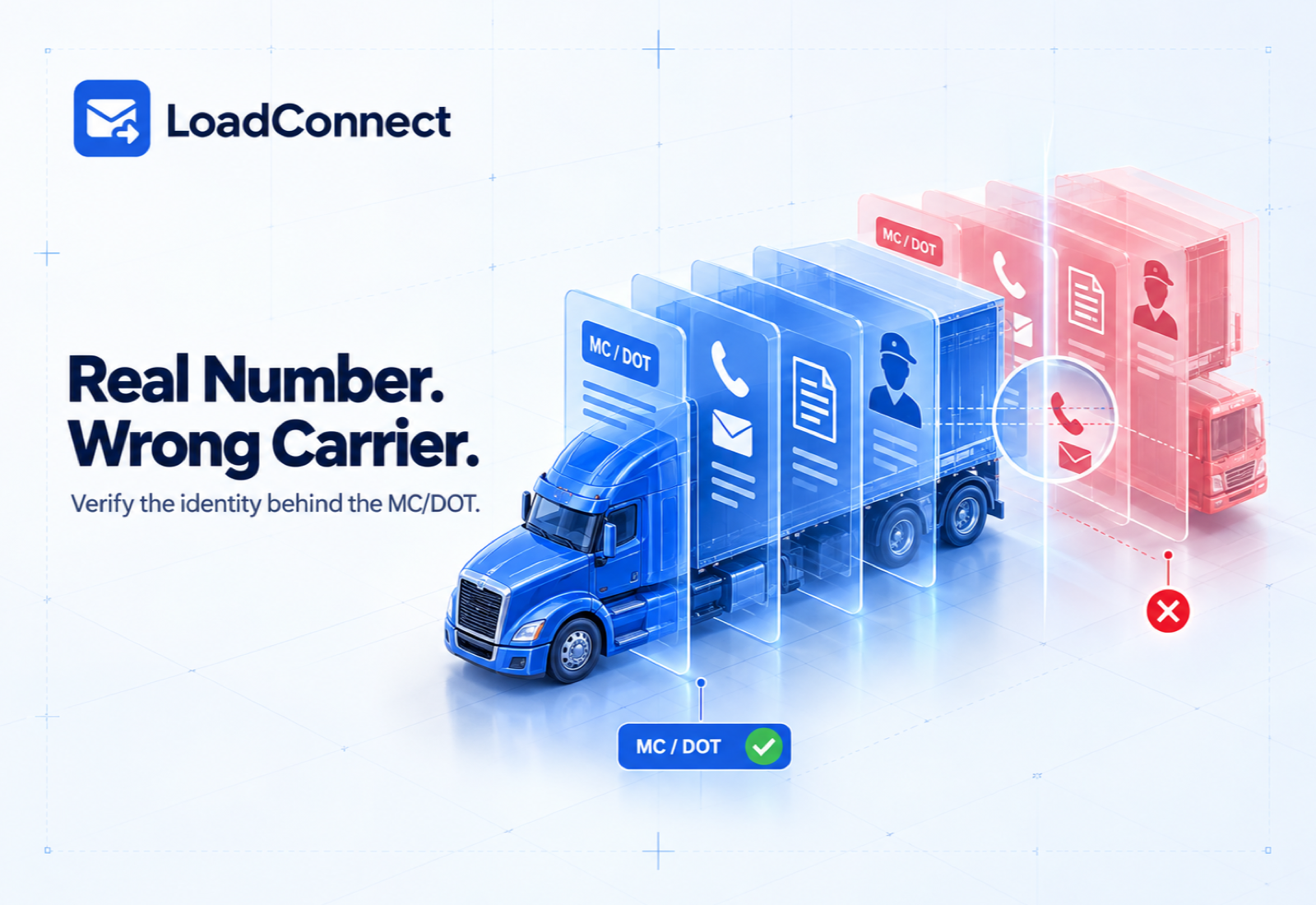
Quick answer: Carrier identity theft happens when a fraudster impersonates a legitimate trucking company by using its MC number, USDOT number, company name, documents, contact information, or other business credentials. A carrier lookup may show a real, active company even when the person trying to book the load has no connection to it. To detect stolen carrier identities, brokers need to verify that the regulatory record, contact information, documents, dispatcher, driver, and equipment all point to the same business.
A carrier can have active authority, valid insurance, years of operating history, and a legitimate USDOT number — and the person contacting a broker can still be a fraudster.
That is what makes carrier identity theft difficult to detect.
Unlike a fake company using obviously invalid credentials, an identity thief may hide behind the real operating authority of an established motor carrier.
For freight brokers, that changes the verification question.
It is no longer enough to ask: “Is this MC number valid?”
Brokers also need to ask: “Is the person using this MC/DOT number actually authorized to represent this carrier?”
That distinction is becoming an increasingly important part of carrier verification.
What Is Carrier Identity Theft in Trucking?
Carrier identity theft occurs when someone uses another motor carrier's identity or credentials without authorization.
The stolen information may include:
- MC number;
- USDOT number;
- legal company name;
- DBA name;
- business address;
- phone number;
- company logo;
- carrier packet;
- W-9;
- insurance documents;
- email format;
- website information;
- dispatcher or employee identity.
The fraudster then uses this information to appear to be the legitimate carrier.
FMCSA specifically identifies identity theft as including unauthorized use of another motor carrier's assigned USDOT number.
This creates an important distinction:
The carrier record can be legitimate while the person using it is not.
What Is a Stolen or Hijacked MC Number?
The terms stolen MC number and hijacked MC number are often used when a fraudster operates under an MC identity belonging to another carrier.
The MC number itself may still belong to an active, legitimate transportation company. The fraudster is not necessarily creating a fake number — they are presenting someone else's credentials as their own.
A typical scenario looks like this:
- A legitimate carrier operates under an active MC/DOT identity.
- A fraudster obtains or copies its company information.
- The fraudster creates a similar email address or uses another phone number.
- A broker receives a quote from someone claiming to represent the carrier.
- The broker checks the MC number and sees valid authority.
- The load is awarded because the regulatory record appears legitimate.
- The person who booked the load was never authorized by the actual carrier.
This is why a stolen carrier identity can be harder to detect than a completely fabricated carrier.
Stolen MC Number vs. Fake MC Number
These two situations are different.
Fake or Invalid MC Number
A person provides an MC number that:
- does not exist;
- belongs to another type of entity;
- is inactive;
- does not match the company presented;
- has no appropriate operating authority.
A regulatory lookup may expose the problem quickly.
Stolen MC Number
The MC number is real. The registered company may also be legitimate. The problem is that the person using the identity has no authority to represent that carrier.
A broker therefore needs to verify both: Carrier legitimacy and Carrier identity
The first determines whether the company exists and can legally operate.
The second determines whether you are actually dealing with that company.
How Do Fraudsters Impersonate Legitimate Carriers?
Carrier impersonation does not always require sophisticated technology. Much of the information needed to imitate a carrier can be collected from public records, company websites, transportation platforms, documents, or compromised communications.
Common tactics include:
Lookalike Email Addresses
A legitimate carrier might use: dispatch@northstarfreight.com
An impersonator could use: dispatch@northstar-freight.com
or: northstarfreight.dispatch@gmail.com
Small differences are easy to miss during a fast booking process.
Different or Spoofed Phone Numbers
A fraudster may use a phone number that has no connection to the registered carrier or may impersonate a real employee.
Copied Carrier Packets
A carrier packet containing legitimate company information can be copied and reused.
Altered Insurance Certificates
A professional-looking Certificate of Insurance should not automatically be treated as proof that the sender represents the insured carrier.
Fake or Copied Websites
Fraudsters may imitate existing carriers or create websites that appear connected to a legitimate business.
Compromised Email Accounts
Not every suspicious message comes from a newly created address. If a real account is compromised, fraudulent communication can appear to originate from the legitimate company.
Why an Active MC/DOT Number Does Not Prove Carrier Identity
Suppose a broker receives a load request from a dispatcher claiming to represent Carrier A.
The broker confirms:
- the carrier exists;
- operating authority is active;
- the USDOT number is legitimate;
- the company has operating history;
- insurance information appears normal.
Those checks establish that Carrier A is real. They do not establish that the dispatcher is Carrier A.
That is the gap carrier identity theft exploits.
The carrier's regulatory identity must therefore be connected to the actual person, documents, communication, and equipment involved in the shipment.
Carrier Identity Theft Red Flags
No single signal proves that a carrier identity has been stolen. The most important warning signs are usually unexplained inconsistencies.
| Signal | Why it matters | What to verify |
|---|---|---|
| Different phone number | Contact may not belong to the registered carrier | Independently sourced carrier phone |
| Lookalike email domain | Fraudster may be impersonating the company | Domain, spelling, previous contacts |
| Conflicting documents | Legitimate documents may have been copied or altered | MC/DOT, legal name, W-9, insurance |
| New payment instructions | Could indicate impersonation or account compromise | Factoring or banking details |
| Recent contact changes | Identity may have been hijacked after onboarding | Phone, email, dispatcher, address |
| Resistance to verification | Fraud often depends on urgency | Independent callback and identity check |
| Truck does not match | Booking identity and physical carrier may differ | Driver, tractor, trailer, USDOT |
| Several small mismatches | Multiple weak signals can form a strong pattern | Entire carrier identity chain |
1. The Phone Number Does Not Match
If the dispatcher uses a number that differs from independently verified carrier information, investigate the discrepancy. There may be a legitimate explanation, but it should be explainable.
For suspicious transactions, contact the carrier using an independently sourced phone number rather than the number supplied by the person requesting the load.
2. The Email Address Is Almost — but Not Quite — Right
Check the entire email address, not just the display name.
Look for:
- extra hyphens;
- substituted letters;
- missing characters;
- unexpected domain extensions;
- free email accounts;
- different domains across documents and communication.
A one-character difference can separate the real carrier from an impersonator.
3. Company Information Does Not Line Up
Compare:
- MC/DOT → legal company name
- Company name → address
- Address → documents
- Company → phone
- Company → email/domain
- W-9 → legal entity
- Insurance → named insured
The objective is to determine whether the overall identity is internally consistent.
4. Payment or Factoring Information Suddenly Changes
Unexpected changes in banking, factoring, or payment details should trigger another identity check.
Confirm sensitive changes using previously trusted contact information instead of replying only to the message requesting the update.
5. The Dispatcher Avoids Independent Verification
Be cautious when someone:
- refuses a callback;
- avoids questions about the company;
- cannot confirm driver or equipment details;
- pressures the broker to skip verification;
- becomes unusually aggressive when identity checks are requested.
Urgency is common in freight.
Resistance to verification is different.
6. The Truck at Pickup Does Not Match the Approved Carrier
Identity verification should continue through pickup.
Depending on the shipment and risk level, confirm:
- company name;
- USDOT number;
- driver's identity;
- tractor number;
- trailer number;
- license plates.
If the equipment cannot be reasonably connected to the approved carrier, the load should not automatically be released.
How to Verify That the Person Using an MC/DOT Number Is the Real Carrier
General carrier vetting covers authority, insurance, safety, references, operating history, and other qualification criteria. That wider process is covered separately in our 10-point carrier vetting checklist for freight brokers.
When identity theft is the concern, focus specifically on proving that the person using the MC/DOT identity is connected to its legitimate owner.
Step 1: Establish the Carrier's Independent Identity
Start with independently sourced carrier information.
Confirm:
- legal name;
- DBA;
- MC number;
- USDOT number;
- address;
- phone number;
- operating status.
Treat this information as the reference profile for the transaction.
Step 2: Compare the Contact Information
Compare the dispatcher-provided information with the independent reference.
Focus on:
- phone number;
- email domain;
- company address;
- website;
- employee identity.
A match does not guarantee legitimacy.
A significant mismatch should be explained before proceeding.
Step 3: Cross-Check Documents
Compare:
- carrier packet;
- W-9;
- insurance documents;
- broker-carrier agreement;
- MC/DOT information;
- contact details.
Do not ask only whether a document looks professional. Ask whether all documents describe the same company.
Step 4: Call an Independently Verified Number
If identity is uncertain, contact the carrier directly using an independently sourced number.
Ask the company to confirm:
- whether the dispatcher works there;
- whether the company is booking the load;
- driver information;
- truck information;
- recent contact or payment changes.
This breaks the verification loop where a suspicious contact is used to validate itself.
Step 5: Confirm Driver and Equipment Identity
Where appropriate, connect the person booking the shipment with the person and equipment actually collecting it.
Verify:
- driver name;
- tractor number;
- trailer number;
- plate information;
- carrier identification.
The regulatory identity, booking identity, and pickup identity should form a coherent chain.
Step 6: Investigate Unexplained Changes
A familiar MC number should not automatically receive permanent trust.
If a known carrier suddenly appears with:
- a different email domain;
- a new phone number;
- a different dispatcher;
- unexpected payment instructions;
verify the change independently.
Step 7: Stop When the Identity Cannot Be Established
If important discrepancies remain unresolved, stop the booking.
An active MC number should never be used to explain away evidence that the person presenting it cannot be connected to the registered carrier.
Carrier Identity Theft vs. Double Brokering
Carrier identity theft and double brokering can occur together, but they describe different problems.
Carrier Identity Theft
Someone uses another carrier's identity or credentials without authorization.
Double Brokering
Freight is transferred or re-brokered without proper authorization or disclosure. A single fraudulent transaction can involve both.
For example:
- A fraudster impersonates Carrier A.
- The broker awards the load to what it believes is Carrier A.
- The fraudster transfers the load to Carrier B.
- Carrier B believes it received a legitimate shipment.
- The broker still believes Carrier A has the freight.
- Payment, cargo, or delivery disputes appear later.
This is why identity mismatches at pickup should not be treated as minor administrative issues.
Carrier Identity Theft vs. Broker Identity Theft
The same identity problem can work in the opposite direction.
Fraudsters may impersonate brokers, misuse brokerage information, issue fraudulent rate confirmations, or arrange freight without legitimate authority.
For carriers and dispatchers checking the other side of the transaction, see our guide to broker fraud in trucking.
The verification question changes depending on the side:
Broker verifying carrier:
“Does this person actually represent the carrier whose MC/DOT identity they are using?”
Carrier verifying broker:
“Does this person actually represent the brokerage offering this load?”
In both cases, a valid company record is only part of the identity check.
Why Carrier Identity Verification Cannot Be a One-Time Check
A carrier can be legitimate when a brokerage first approves it and still be impersonated later.
Identity risk can emerge because:
- company information is copied;
- an email account is compromised;
- a fraudulent domain is created;
- a phone number is spoofed;
- carrier documents are stolen;
- payment information is manipulated.
That makes identity verification an ongoing process:
Onboarding → Booking → Pre-pickup → Pickup → Payment
Different anomalies can appear at different stages.
During onboarding: company or document information does not match.
During booking: a new dispatcher appears from an unfamiliar email domain.
Before pickup: driver or truck details change unexpectedly.
At pickup: the equipment does not correspond to the approved carrier.
Before payment: new factoring or banking instructions appear.
The MC number may remain exactly the same throughout the entire scheme, which is why carrier verification should focus not only on the original onboarding check but also on changes that appear later in the relationship. Tools such as LoadConnect Carrier Verification can support this process by monitoring signals such as authority, insurance, risk indicators, and carrier contact information as part of the broker workflow.
How AI Can Help Surface Carrier Identity Risk
Carrier identity verification requires brokers to compare information from multiple places:
- FMCSA records;
- MC/DOT data;
- authority information;
- insurance;
- contact details;
- documents;
- historical carrier information;
- operational communication.
The challenge is often not a lack of data.
It is recognizing the inconsistency before the load is released.
AI-assisted systems can support this process by helping surface exceptions such as:
- mismatched identifiers;
- inconsistent company information;
- unexpected contact changes;
- missing verification data;
- unusual document information;
- authority or insurance changes;
- other risk signals requiring review.
The important distinction is that AI should support the decision rather than replace verification. AI is most useful when it helps answer:
“What is unusual here, and what needs a human to verify before we proceed?”
This fits the broader AI Dispatch workflow, where operational and risk information is brought closer to the point at which a broker or dispatcher makes a decision.
For the wider category, see our guide to AI Dispatch.
What Should Brokers Do If They Discover a Stolen Carrier Identity?
If you suspect that someone is using another carrier's MC/DOT identity, stop the transaction until the identity is resolved.
Preserve:
- email addresses;
- email headers where available;
- phone numbers;
- carrier packets;
- W-9s;
- insurance documents;
- rate confirmations;
- payment instructions;
- factoring information;
- driver details;
- tractor and trailer information;
- license plates;
- screenshots;
- timestamps;
- chat or text conversations.
Then contact the legitimate carrier through independently verified information.
If freight is already in transit, remember that the actual carrier may also be a victim rather than a participant in the fraud.
Suspected identity theft or fraud should also be reported through the appropriate FMCSA, law-enforcement, and federal fraud-reporting channels.
What Should a Carrier Do If Its MC/DOT Identity Is Stolen?
If your carrier information is being used without authorization:
- confirm that your federal registration information is accurate;
- make sure legitimate phone information is current;
- notify your insurance company;
- notify relevant load boards;
- notify factoring partners;
- preserve evidence of fraudulent communications;
- warn existing customers where appropriate;
- report the activity through relevant government and law-enforcement channels.
USDOT numbers are tied to the legal person to whom they are assigned and should not be sold, leased, rented, or transferred to unrelated operators.
Carrier Identity Verification Checklist
When identity theft is suspected, confirm:
- MC number belongs to the company being presented.
- USDOT number belongs to the same legal entity.
- Legal name matches across records and documents.
- Phone number can be independently connected to the carrier.
- Unexpected phone numbers are explained.
- Email domain belongs to or clearly connects to the carrier.
- Carrier packet and W-9 describe the same legal entity.
- Questionable insurance information can be independently confirmed.
- Dispatcher can be connected to the registered carrier.
- Driver can be connected to the booked carrier.
- Truck at pickup matches the approved carrier.
- Payment or factoring changes have been verified.
- No significant identity inconsistency remains unresolved.
For authority, insurance, safety data, references, and the wider qualification process, use the separate carrier vetting checklist.
Frequently Asked Questions
What is carrier identity theft?
Carrier identity theft occurs when someone uses another motor carrier's MC number, USDOT number, company information, documents, or other credentials without authorization to impersonate that carrier.
What is a hijacked MC number?
A hijacked MC number is commonly understood as unauthorized use of a legitimate carrier's MC identity. The carrier may be real and active while the person using its credentials is not authorized to represent it.
How can a broker tell if an MC number is stolen?
Look beyond the MC record. Compare the phone number, email, legal name, documents, dispatcher identity, driver information, and equipment with independently sourced carrier information. Unexplained mismatches are the strongest warning signs.
Does active FMCSA authority prove the person contacting me is legitimate?
No. Active authority confirms the status of the registered carrier. It does not prove that the person communicating with you is authorized to represent that carrier.
Is carrier identity theft the same as double brokering?
No. Carrier identity theft involves unauthorized use of another carrier's identity. Double brokering involves transferring freight without proper authorization or disclosure. One fraudulent shipment can involve both.
Can AI detect a stolen carrier identity?
AI can help surface inconsistencies and unusual changes across carrier data, but it should be used as decision support rather than definitive proof that a carrier is legitimate or fraudulent.
Verify the Identity Behind the MC Number
Carrier identity theft exploits a simple weakness in traditional verification:
A real carrier record can be used by the wrong person.
That means an active MC number, USDOT number, authority record, or professional carrier packet cannot independently answer the most important question:
Are you actually dealing with the company that owns these credentials?
A stronger process connects regulatory identity with real-world identity:
MC/DOT data + contact information + documents + dispatcher + driver + equipment + transaction history.
For complete carrier qualification, brokers still need broader vetting around authority, insurance, safety, operating history, and other risk signals.
But when identity theft is the threat, the objective is more specific:
Verify the carrier behind the credentials — not just the credentials themselves.
LoadConnect Carrier Verification helps bring MC/DOT data, authority information, insurance, and carrier risk signals into the brokerage workflow so teams can investigate inconsistencies before making a booking decision.